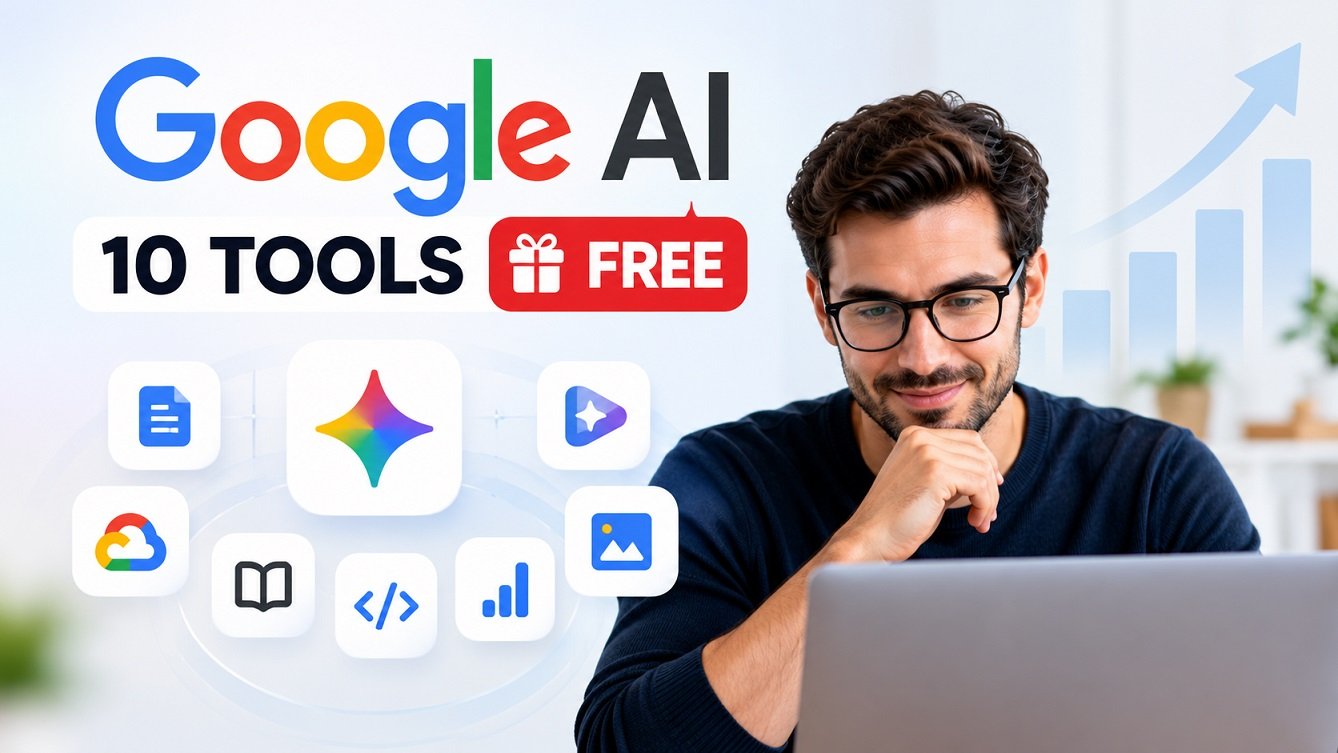
Artificial intelligence is no longer limited to large technology companies or teams of highly specialized developers. In 2026, entrepreneurs, marketers, freelancers, startups, and small-business owners can use AI to research ideas, create content, analyze information, generate images and videos, write code, and improve everyday productivity.
And you don’t always need an expensive software subscription to get started.
Google has built a growing ecosystem of AI-powered products and services, including tools and resources that offer free access or free usage options. For entrepreneurs looking for free AI tools from Google, these resources provide an accessible way to experiment with artificial intelligence and discover how it can support business growth.
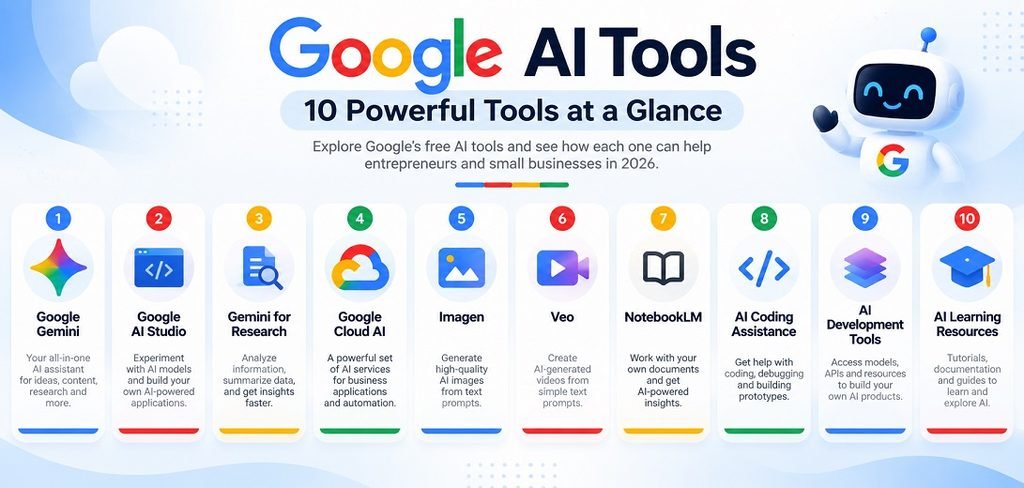
In this guide, we’ll explore 10 Google AI tools and resources that entrepreneurs can explore in 2026, what they are designed to do, and how they may be useful for small businesses.
Important: Google’s AI products, features, pricing, and free usage limits can change over time. Some tools offer free access with limitations, while advanced features or higher usage may require a paid plan. Always check Google’s current terms and pricing before relying on a tool for a business-critical workflow.
Why Google AI Tools Matter for Entrepreneurs
Small businesses often operate with limited budgets and small teams. That makes productivity particularly important.
AI can help entrepreneurs accomplish certain tasks faster, including research, brainstorming, writing, analysis, coding, customer communication, and content production.
The opportunity isn’t necessarily about replacing people with AI. Instead, entrepreneurs can use AI to reduce repetitive work and give their teams more time to focus on strategy, customers, creativity, and decision-making.
That’s why free AI tools 2026 has become an increasingly important topic for startups and small businesses looking to experiment with AI without making a significant upfront investment.
10 Free AI Tools From Google to Explore in 2026
1. Google Gemini
Google Gemini is Google’s family of generative AI models and one of the company’s most prominent AI products.
Gemini can assist with a wide range of tasks, including brainstorming, writing, summarization, research, document analysis, coding, and content development.
For entrepreneurs, Gemini can function as a general-purpose AI assistant.
Potential business uses
- Brainstorming business ideas
- Developing content strategies
- Writing and improving emails
- Creating social media concepts
- Summarizing documents
- Developing marketing ideas
- Organizing information
- Assisting with coding
- Creating initial content drafts
For example, a small-business owner could use Gemini to brainstorm a month’s worth of content ideas and then turn the best concepts into blog posts, LinkedIn content, email campaigns, or short-form video scripts.
However, AI-generated material should always be reviewed by a human before publication.
2. Google AI Studio
Google AI Studio is designed for experimenting with Google’s generative AI models and developing AI-powered applications.
It is particularly useful for developers, technical entrepreneurs, startups, and anyone who wants to move beyond simply chatting with AI and begin experimenting with AI-powered applications.
Entrepreneurs can use AI Studio to:
- Experiment with prompts
- Test AI models
- Prototype AI applications
- Explore generative AI capabilities
- Develop early product concepts
- Test an AI business idea
For a startup founder, experimenting with AI Studio can be a practical way to validate an AI product concept before committing substantial development resources.
3. Gemini for Research and Information Analysis
Entrepreneurs spend a surprising amount of time researching competitors, markets, customers, products, and business opportunities.
AI can help make the first stage of this process faster.
Gemini can assist with summarizing information, organizing ideas, identifying patterns, generating research questions, and turning large amounts of information into more manageable summaries.
For example, a business owner could analyze a collection of customer comments and ask AI to identify recurring problems, frequently requested features, and potential opportunities.
AI shouldn’t replace proper market research, but it can make preliminary research considerably more efficient.
4. Google Cloud AI Services
Google Cloud provides a much broader AI ecosystem for businesses and developers.
While a small business owner who simply wants an AI writing assistant may not need Google Cloud, companies building software products or sophisticated digital workflows may find these services much more relevant.
Google Cloud’s AI capabilities can support applications involving:
- Customer service
- Data analysis
- Document processing
- AI-powered search
- Recommendations
- Automation
- Predictive analytics
- Generative AI
For example, a software startup could use cloud-based AI services as part of an application rather than relying solely on a consumer-facing chatbot.
This is where businesses can begin moving from using AI to building with AI.
5. Imagen and AI Image Generation
Visual content has become an essential part of digital marketing.
Google’s Imagen technology is part of its generative AI ecosystem and can be used for AI-powered image generation in supported Google products and services.
For marketers and entrepreneurs, generative image technology can help with creative exploration and visual content concepts.
Potential applications include:
- Social media graphics
- Marketing concepts
- Blog illustrations
- Advertising concepts
- Presentation visuals
- Creative prototypes
- Product concepts
Businesses should always check the specific commercial-use, licensing, and usage terms associated with the Google product or service they are using.
6. Veo and AI Video Generation
Video marketing continues to be important for businesses, but traditional video production can require significant time, equipment, and budget.
Google’s Veo models are designed for generative video creation and can produce video content from prompts in supported experiences.
For entrepreneurs, AI video technology can be useful for experimenting with:
- Short-form marketing videos
- Creative concepts
- Storyboards
- Product demonstrations
- Social media content
- Advertising ideas
AI-generated video is developing quickly, but professional review is still important when accuracy, brand identity, product representation, or customer trust matters.
7. NotebookLM
NotebookLM is Google’s AI-powered research and information-assistance tool.
It can be particularly useful when an entrepreneur needs to work with a collection of source materials rather than simply asking general questions.
Depending on the supported sources and current product capabilities, entrepreneurs can use NotebookLM to organize and interact with business information such as:
- Reports
- Research documents
- Meeting materials
- Product documentation
- Educational resources
- Business notes
Imagine a founder preparing for an important meeting with investors or business partners. An AI research assistant could help organize the source material, summarize important points, and identify questions that deserve further investigation.
This can save time without removing the need for human judgment.
8. Google AI Coding Assistance
AI-assisted coding is another area where Google’s AI ecosystem can help entrepreneurs.
Not every founder has a development team available to build every small tool or automation they need.
Gemini AI coding assistance can help users understand programming concepts, create code drafts, troubleshoot errors, and prototype simple applications.
Possible uses include:
- Generating sample code
- Explaining programming concepts
- Debugging
- Creating scripts
- Building prototypes
- Automating repetitive technical tasks
- Exploring software ideas
However, AI-generated code should always be reviewed, tested, and secured before being used in production—particularly when applications involve payments, authentication, customer information, or other sensitive data.
9. Google Cloud AI Development Tools
Google Colud Vertex AI provides developers with models, APIs, documentation, development resources, and other tools for creating AI-powered applications.
This can be particularly valuable for startups that want to build their own AI products instead of simply using existing consumer AI applications.
A startup could begin by experimenting with free AI resources, validate whether customers actually want its proposed solution, and then move toward a more sophisticated production architecture as demand grows.
This approach can help reduce the risk associated with investing heavily in an untested idea.
10. Google’s AI Learning and Experimentation Resources
One of the most overlooked opportunities for entrepreneurs is simply learning how AI works and experimenting with different Google AI capabilities.
Google Cloud Ai Training & Learning” provides a growing collection of AI documentation, tutorials, development resources, model information, and educational materials.
For a business owner who is still learning about AI, these resources can provide a starting point for understanding:
- Generative AI
- AI models
- Prompt engineering
- AI application development
- AI automation
- Responsible AI
- Machine learning
You don’t need to become an AI engineer to benefit from AI.
Understanding what these technologies can and cannot do can help entrepreneurs make better technology decisions.
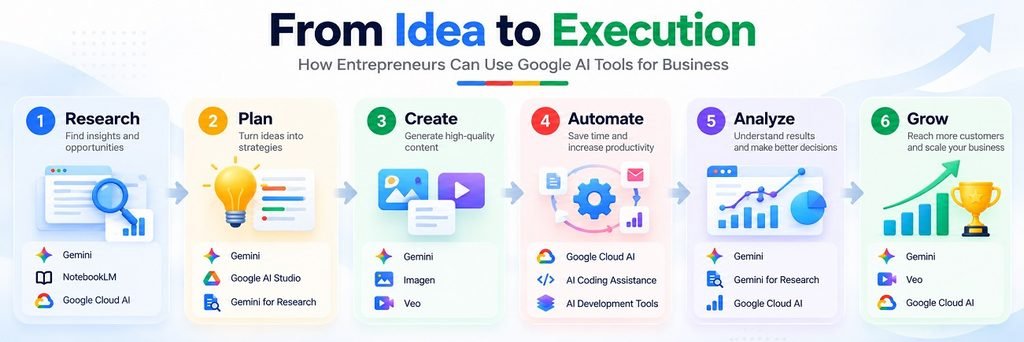
How Entrepreneurs Can Use Free Google AI Tools
Having access to AI is one thing. Using it effectively is another.
The greatest value usually comes from connecting AI tools to real business processes.
Content Marketing
AI can help businesses brainstorm topics, create outlines, repurpose content, develop social media ideas, and improve early drafts.
For example, one detailed article could potentially be transformed into:
- LinkedIn posts
- Email content
- Social media updates
- Video scripts
- FAQ content
- Short-form content ideas
The human editor still plays an important role in maintaining accuracy, originality, expertise, and brand voice.
SEO
AI can support several stages of an SEO workflow.
Entrepreneurs can use AI to:
- Brainstorm content topics
- Develop content briefs
- Organize questions
- Understand potential search intent
- Create article structures
- Generate content ideas
- Repurpose existing content
However, AI shouldn’t become an excuse to publish hundreds of low-quality pages.
Successful SEO still depends on useful, original, relevant content that genuinely satisfies users.
Social Media Marketing
Maintaining a consistent social media presence can be difficult for small businesses.
AI can help generate:
- Content ideas
- Captions
- Campaign concepts
- Video ideas
- Content calendars
- Audience-specific messaging
A strong social media strategy should still come from the business. AI can help accelerate execution.
Customer Service
AI can help businesses organize frequently asked questions and create draft responses to common customer inquiries.
More advanced businesses can also explore AI-powered customer-support applications using cloud AI technologies.
The goal should be to improve the customer experience—not simply automate every customer interaction.
Business Research
Entrepreneurs can use AI to summarize documents, organize research, compare ideas, and identify areas that require additional investigation.
This can be especially useful during the early stages of product development or business planning.
Productivity and Automation
Perhaps the biggest opportunity is using AI to reduce repetitive tasks.
A simple workflow could look like:
Research → AI-assisted analysis → Human review → Content creation → Editing → Publishing
Once a workflow has been tested and refined, entrepreneurs can explore additional automation tools to connect different systems.
Are Google’s AI Tools Really Free?
This is where business owners need to be careful.
Some Google AI products and services offer free access or free usage tiers, but free does not necessarily mean unlimited.
Limits can vary depending on the product, model, account, location, usage level, and type of service.
Google may change:
- Free usage limits
- Available models
- Features
- API quotas
- Pricing
- Eligibility requirements
- Regional availability
Therefore, entrepreneurs should verify the current Google documentation and pricing information before building an important business process around a free service.
A free tier can be excellent for testing and experimentation.
It may not be sufficient for a high-volume production environment.
Free AI Tools vs. Paid AI Tools
The question isn’t always whether a business should use free or paid AI.
A better question is:
What level of AI capability does the business actually need?
| Business Need | Free AI May Be Enough | Paid AI May Be Better |
|---|---|---|
| Brainstorming | ✓ | |
| Basic content ideas | ✓ | |
| Occasional research | ✓ | |
| Simple productivity tasks | ✓ | |
| High-volume content production | ✓ | |
| Large-scale API usage | ✓ | |
| Advanced automation | ✓ | |
| Production AI applications | ✓ | |
| Larger team workflows | ✓ |
The objective should be to choose technology based on business requirements—not simply because a particular AI product is popular.
Why Free AI Tools Are Important for Small Businesses
Large companies can spend substantial amounts of money experimenting with emerging technologies.
Small businesses generally need to be more careful with their technology budgets.
That’s why free Google AI tools can be so useful.
They allow entrepreneurs to test ideas before making significant investments.
For example, imagine a small business wants to create an AI-powered customer-support system.
Instead of immediately spending thousands of dollars, the business could:
- Identify a specific customer problem.
- Test an AI solution manually.
- Build a basic prototype.
- Collect feedback.
- Measure the potential business value.
- Improve the workflow.
- Invest in a larger solution only when justified.
This approach allows entrepreneurs to experiment while controlling costs.
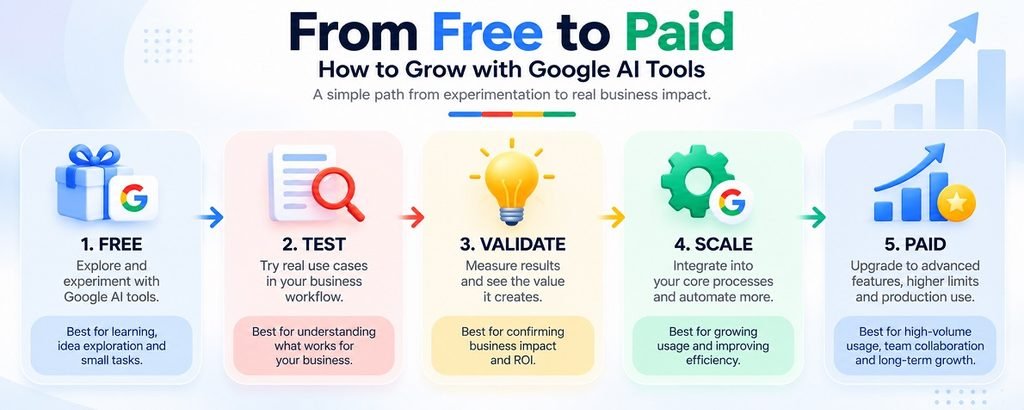
How to Build an AI Workflow on a Small Budget
You don’t need dozens of AI subscriptions to start.
A practical approach is to begin with one specific problem.
Step 1: Identify a repetitive task
Find something that consumes time every week.
Step 2: Test an AI tool
Try a free Google AI option to determine whether it can actually help.
Step 3: Create a repeatable workflow
Document the prompts, instructions, inputs, and expected outputs.
Step 4: Add human review
Check facts, accuracy, quality, tone, originality, and brand consistency.
Step 5: Measure the results
Determine whether the workflow saves time, improves quality, increases productivity, or generates measurable business value.
Step 6: Upgrade only when necessary
If the free option becomes restrictive, consider a paid plan, API, automation platform, or custom solution.
This prevents entrepreneurs from spending money on AI tools simply because they are trending.
Important Things to Remember Before Using AI for Business
AI can be powerful, but entrepreneurs should approach it responsibly.
Don’t blindly trust AI-generated information
AI systems can produce inaccurate, incomplete, or outdated information.
Important business facts should always be verified.
Protect confidential information
Avoid sharing sensitive customer, financial, legal, proprietary, or confidential information unless you understand how the relevant AI service handles that data.
Keep humans involved
AI can assist with analysis and content creation, but people should remain responsible for important business decisions.
Prioritize quality over quantity
Generating hundreds of AI-written articles doesn’t automatically create a successful marketing strategy.
Useful, original, experience-driven content is much more valuable.
Review commercial-use requirements
Before using AI-generated images, videos, text, or other assets commercially, review the applicable terms for the specific Google product or service.
The Bigger Opportunity: Using AI as a Business Advantage
The most important lesson for entrepreneurs isn’t that Google offers free AI tools.
It’s that AI is becoming increasingly accessible to businesses of all sizes.
A solo entrepreneur can now experiment with technologies that previously required specialized teams and significant budgets.
A small marketing agency can use AI to accelerate research and content workflows.
A startup can prototype an AI-powered product before building a full production system.
A local business can use AI to improve customer communication and marketing.
The competitive advantage comes from identifying where AI can create real value—and implementing it thoughtfully.
How Holinex Digital Can Help Your Business
AI tools can make marketing faster and more efficient, but selecting the right technologies and integrating them into a practical strategy can be challenging.
Holinex Digital helps businesses combine digital marketing expertise with modern AI and automation technologies to develop more efficient, results-focused marketing workflows.
Our services include SEO, Google Ads, content marketing, social media marketing, lead generation, and AI-powered marketing strategies designed to help businesses improve online visibility and connect with high-intent audiences.
Whether you’re a small business exploring AI for the first time or an established company looking to improve an existing digital marketing strategy, the right combination of technology, human expertise, and data-driven decision-making can create a stronger foundation for sustainable growth.
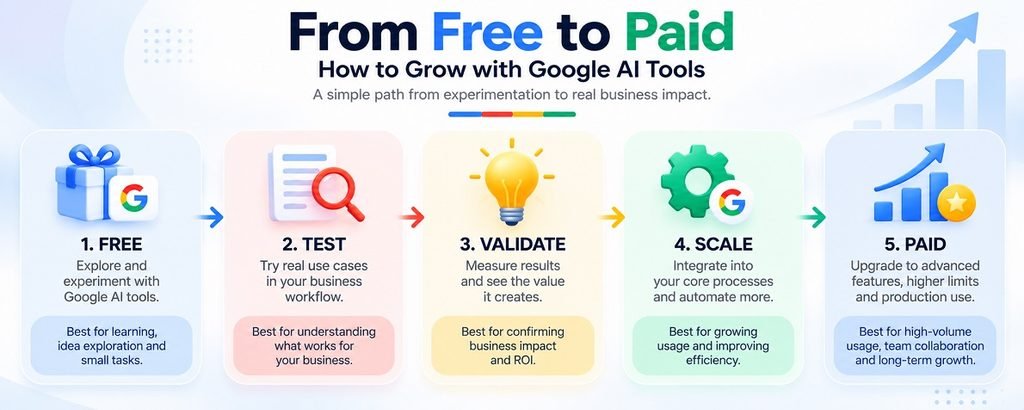
AI is becoming more accessible to entrepreneurs, startups, and small businesses. Google’s growing AI ecosystem provides multiple ways to experiment with artificial intelligence without immediately making a major investment.
From Google Gemini and NotebookLM to AI development tools, image and video generation, and Google Cloud services, entrepreneurs have a growing number of options to explore.
But the real advantage isn’t having access to the largest number of AI tools.
It’s knowing which tool to use, when to use it, and how to connect it to a real business objective.
For entrepreneurs in 2026, starting with free AI tools from Google can be a practical way to learn about AI, experiment with new workflows, improve productivity, and discover opportunities for business growth.
As your needs increase, you can then decide which tools deserve a place in your long-term technology stack.
Frequently Asked Questions
What are the best free AI tools from Google in 2026?
Google Gemini, NotebookLM, Google AI Studio, and various Google Cloud AI resources are among the Google AI options entrepreneurs can explore. Availability, features, and free usage limits can vary by product and region.
Is Google Gemini free?
Google provides free access to Gemini with certain features and usage limits, while additional capabilities may be available through paid plans. Because Google’s offerings can change, users should check the current official Gemini information for the latest details.
Can small businesses use Google AI tools?
Yes. Small businesses can use Google’s AI ecosystem for tasks such as brainstorming, research, content creation, productivity, coding, customer support, marketing, and AI application development.
Are Google’s AI tools completely free?
Not necessarily. Some Google AI products offer free access or free usage tiers, while advanced features, higher usage levels, or production services may require payment.
Can AI replace employees in a small business?
AI can automate or accelerate certain tasks, but it shouldn’t automatically be viewed as a replacement for employees. In many cases, businesses can achieve better results by combining AI with human expertise and decision-making.
Are free AI tools good enough for business?
They can be useful for experimentation, research, brainstorming, productivity, and lower-volume workflows. As a company’s requirements grow, it may need paid plans, APIs, automation platforms, or dedicated AI solutions.
About the Author
Holinex Digital is a digital marketing agency specializing in SEO, Google Ads, social media marketing, content marketing, lead generation, and AI-powered digital marketing solutions. The company helps businesses improve their online visibility, connect with high-intent audiences, and build sustainable digital growth strategies.
With extensive experience serving businesses across the United States, United Kingdom, Europe, Canada, Australia, and other markets, the Holinex Digital team regularly explores emerging technologies, AI tools, search trends, and digital marketing strategies that can create practical value for businesses.
Through its educational content, Holinex Digital shares practical insights on AI tools, SEO, Google Ads, marketing automation, content marketing, and digital growth to help entrepreneurs and small-business owners make smarter technology and marketing decisions.
Please see our Reviews on Google or TechBehmoth to know what the client says about holinex Digital