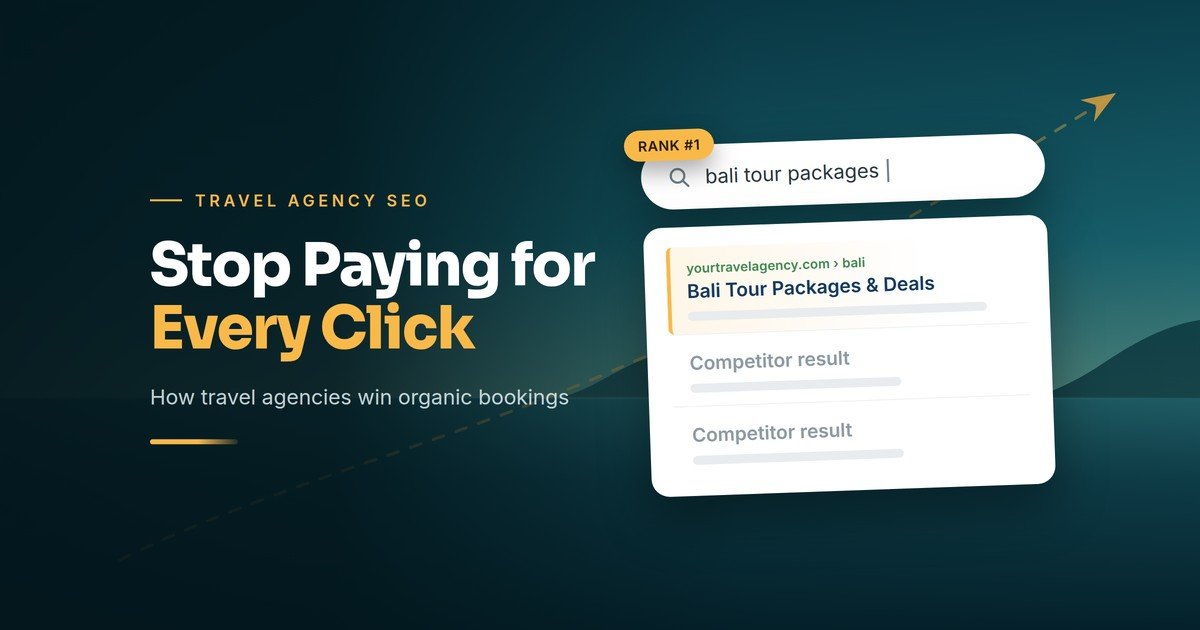
Most travel agencies still lean on ads, social media, or word of mouth. Those channels work — but every month the bill shows up again, and the moment you stop paying, the traffic stops too. SEO doesn’t work that way. Done properly, it keeps bringing people to your site long after the work is done.
Travel agency SEO simply means making sure your website shows up when someone searches for a trip, a destination, a package, or a local agency. Yes, the competition is real. But here’s the thing most people miss: a lot of travel websites out there are slow, thin, and clearly written in a hurry. That’s your opening.
Here’s what actually moves the needle.
Why SEO Matters for Travel Agencies
Nobody walks into an office to plan a holiday anymore. They open their phone and type things like “best honeymoon packages,” “family vacation deals,” “flights and hotels in Bali,” or “travel agency near me.” If you’re not in those results, you’re not in the conversation at all — the customer never even knows you exist.
Good SEO helps you:
- Show up in Google when people are actually planning
- Build trust before anyone picks up the phone
- Reach travellers who already want to travel
- Stop depending on ad spend to keep the lights on
Key SEO Strategies for Travel Agencies
1. Optimize for Local and Destination Searches
Travellers search in two directions: “who’s nearby that I can talk to,” and “who does the trip I want.” You need to answer both.
Make sure your site clearly shows:
- Where you’re based and which areas you serve
- Destination pages of their own — “Bali Tour Packages,” “Europe Vacation Deals,” one page per destination
- Contact details that are easy to find, not buried in a footer
If you deal with walk-in or local clients, claim and fill out your Google Business Profile properly. Photos, hours, services, the lot. It’s free, it takes an afternoon, and it’s often the difference between appearing on Google Maps and not. Google explains its local ranking signals here if you want the details straight from the source.
2. Create Useful Destination and Package Content
A package page with a price, three photos and a “Book Now” button isn’t going to rank. There’s nothing on it for Google to understand or for a traveller to trust.
The pages that do well usually cover:
- What the destination is actually like
- Exactly what’s included — and what isn’t
- Who the trip suits: families, couples, groups, solo travellers
- The practical stuff — best time to visit, visa requirements, what to pack
- A clear next step
Write for the person who’s still deciding, not just the one with a card in hand. Google’s own helpful content guidance says roughly the same thing: answer the question properly and the rankings tend to follow.
3. Target the Right Keywords
Not every keyword deserves your time. “Cheap flights” has enormous volume and almost no chance of turning into a booking for you. Go for terms where intent is obvious:
- “all-inclusive Mexico packages”
- “guided tours to Italy”
- “travel agency for group trips”
- “custom honeymoon packages”
Blend broad destination terms with specific service terms. The broad ones bring traffic; the specific ones bring enquiries. You need both, but the specific ones pay the bills first. If you’re not sure where to start, our SEO services team can map this out for your market.
4. Improve Technical SEO and Page Speed
Travel sites are heavy by nature — big hero images, galleries, booking widgets, maps. All of it adds weight, and weight costs you rankings and bookings.
Check that your site is:
- Genuinely mobile-friendly, not just “it loads on a phone”
- Fast — run it through PageSpeed Insights and see for yourself
- Simple to navigate, so nobody gets lost between destination and enquiry form
- Secure (HTTPS)
Technical problems are the quiet killers. Your content can be excellent and still go nowhere because the page takes six seconds to load on 4G. Google’s SEO starter guide covers the fundamentals worth getting right.
5. Build Trust with Reviews and Experience Signals
People are handing you money for something they can’t see, touch, or return. That’s a big ask. They need reassurance.
Ask happy clients for Google reviews — most will say yes if you actually ask. Put real testimonials on your package pages, not a generic carousel on the homepage. Mention your licences, your years in business, your airline or hotel partnerships. Show the faces of your team. All of it quietly says: we’re real, and people have travelled with us before.
Simple SEO Focus Areas for Travel Agencies
| Area | What to Focus On | Why It Helps |
|---|---|---|
| Google Business Profile | Complete profile, photos, reviews | Local visibility |
| Destination pages | Helpful, detailed content | Ranks for trip-related searches |
| Package pages | Clear details + strong calls to action | Converts traffic into inquiries |
| Blog / Guides | Travel tips, itineraries, destination guides | Attracts top-of-funnel traffic |
| Technical SEO | Speed, mobile, clean structure | Better rankings and user experience |
Common Mistakes to Avoid
- Copying generic descriptions from supplier sites or other agencies
- Chasing only the biggest, most competitive keywords
- Ignoring mobile users, when most travel research happens on a phone
- Uploading full-size images and wondering why pages crawl
- Treating SEO as a one-time setup instead of something you keep at
Frequently Asked Questions (FAQs)
How long does travel agency SEO take to show results?
Usually a few months of steady work before you see meaningful movement. Competitive destinations take longer. Anyone promising page one in four weeks is selling you something.
Is local SEO important for travel agencies?
Very much so, especially if you serve a particular city or region. Plenty of people still search for an agency they can visit or call.
Should travel agencies focus more on blogs or package pages?
Both, and they do different jobs. Guides bring in people who are still dreaming; package pages catch them once they’re ready to book.
Can SEO reduce the need for paid ads?
Over time, yes. Most agencies that build up organic traffic cut their ad spend noticeably — though a sensible mix of both usually works best.
Do small travel agencies still have a chance against big brands?
Absolutely. The big aggregators are often slow and impersonal. A smaller agency with genuinely useful content and real local presence can outrank them on the searches that matter.
Ready to Improve Your Travel Agency’s Visibility?
Strong SEO puts you in front of people at the exact moment they’re planning a trip. Useful destination content, honest package pages, a fast site, and solid local signals — that combination adds up over time.
If you’d like help with SEO strategy, local search, or your wider digital marketing, get in touch with Holinex — we’re happy to take a look at where you stand.